AI is the system.
Not bolted on top.
The case management system built for the way modern litigation actually works. Agents organize discovery, brief every matter overnight, and flag the cases going sideways — before the client calls.

Three steps. Two of them are done before you log in.
A matter arrives.
Email, intake call, signed retainer — Valentine catches it from any direction.
The agents go to work.
Routes documents to the right matter. Builds the case file. Flags the matters going sideways.
You review and ship.
Or redirect — the system tracks how often it got it right.
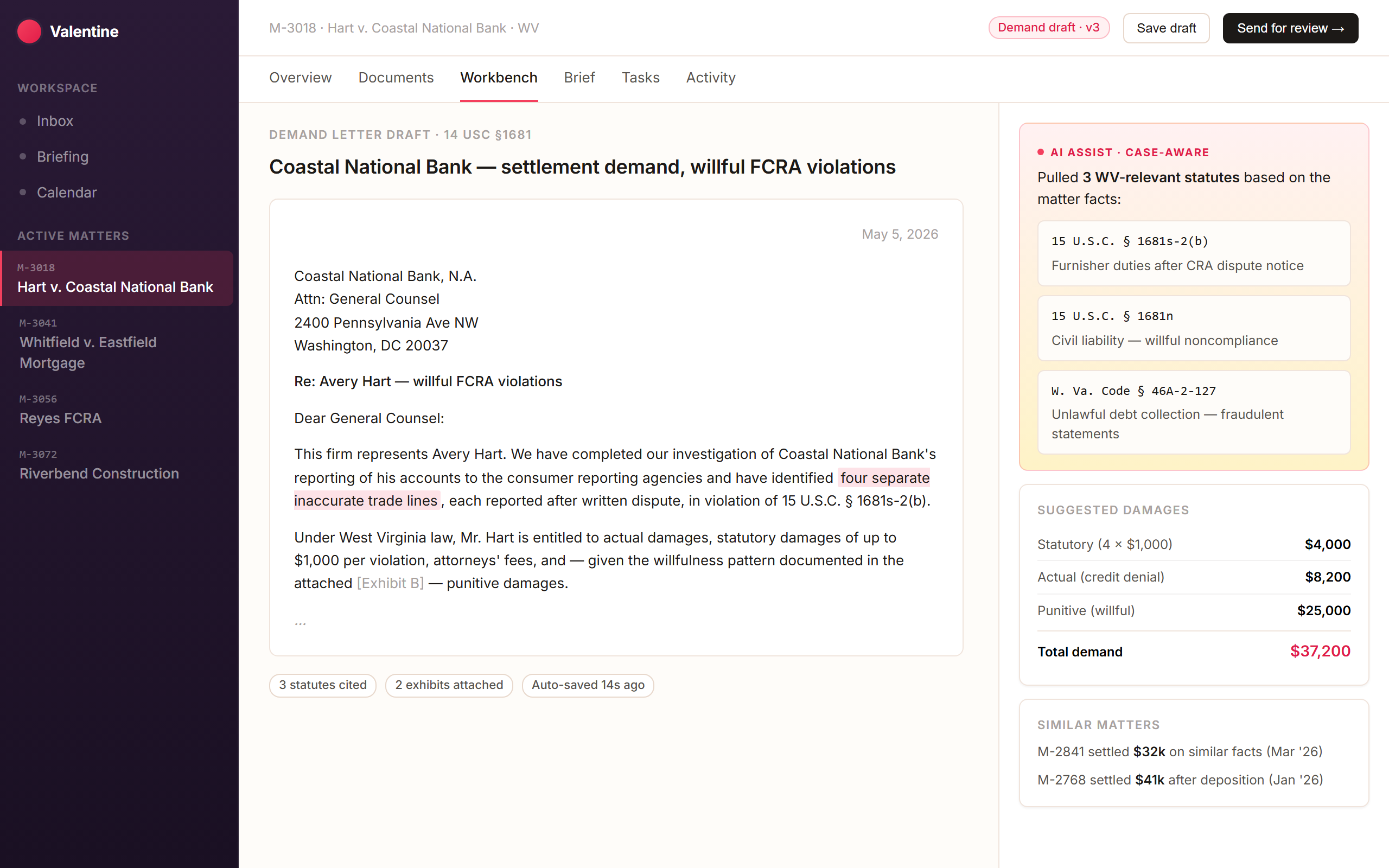
Statute lookup, draft, edit — in one place.
The Workbench lives next to the matter, drafts from the facts already in Valentine, and hands the plan back for lawyer review. You're not copy-pasting context into a blank chat window — you're doing the lawyer parts.
See the workbench in motion →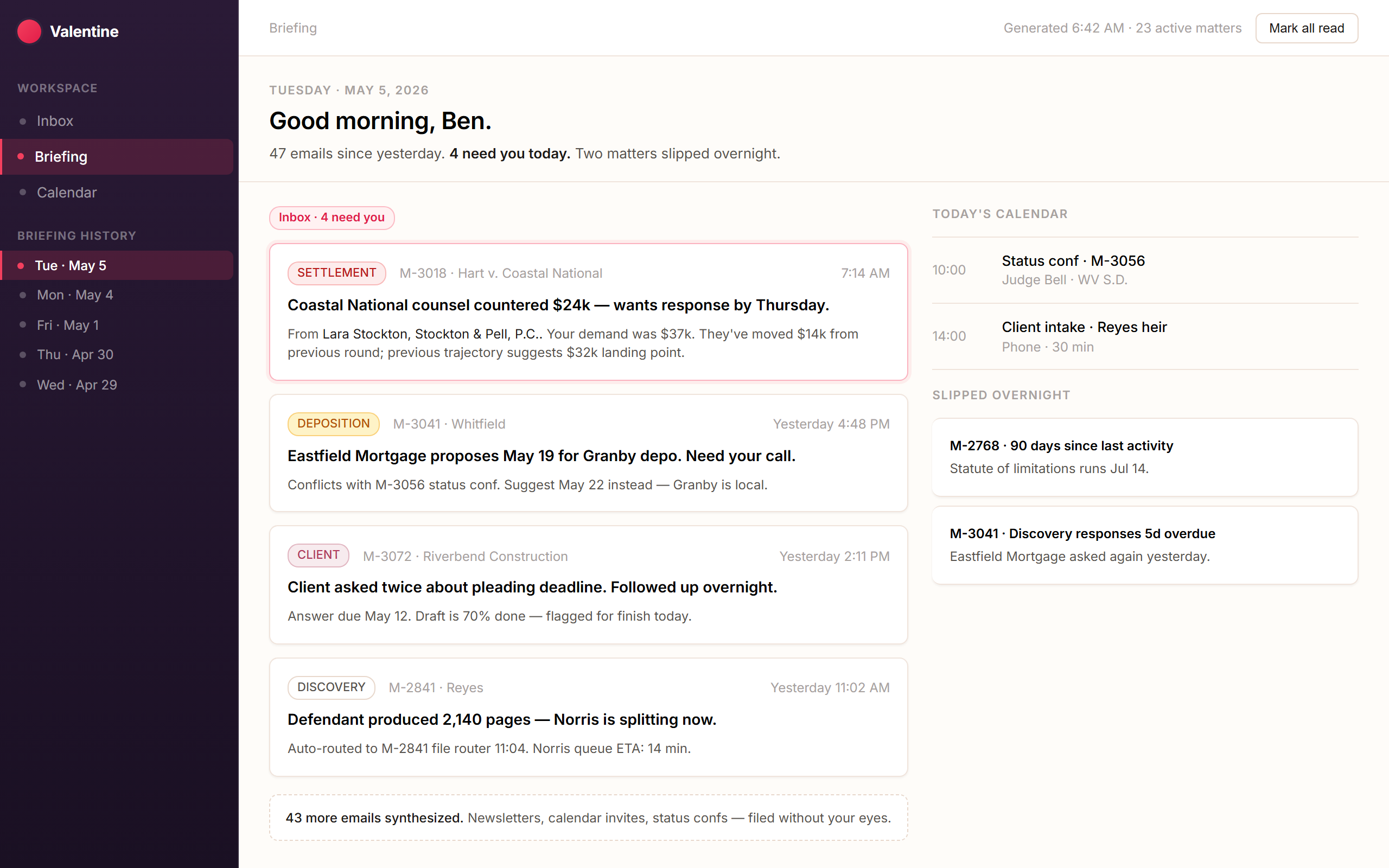
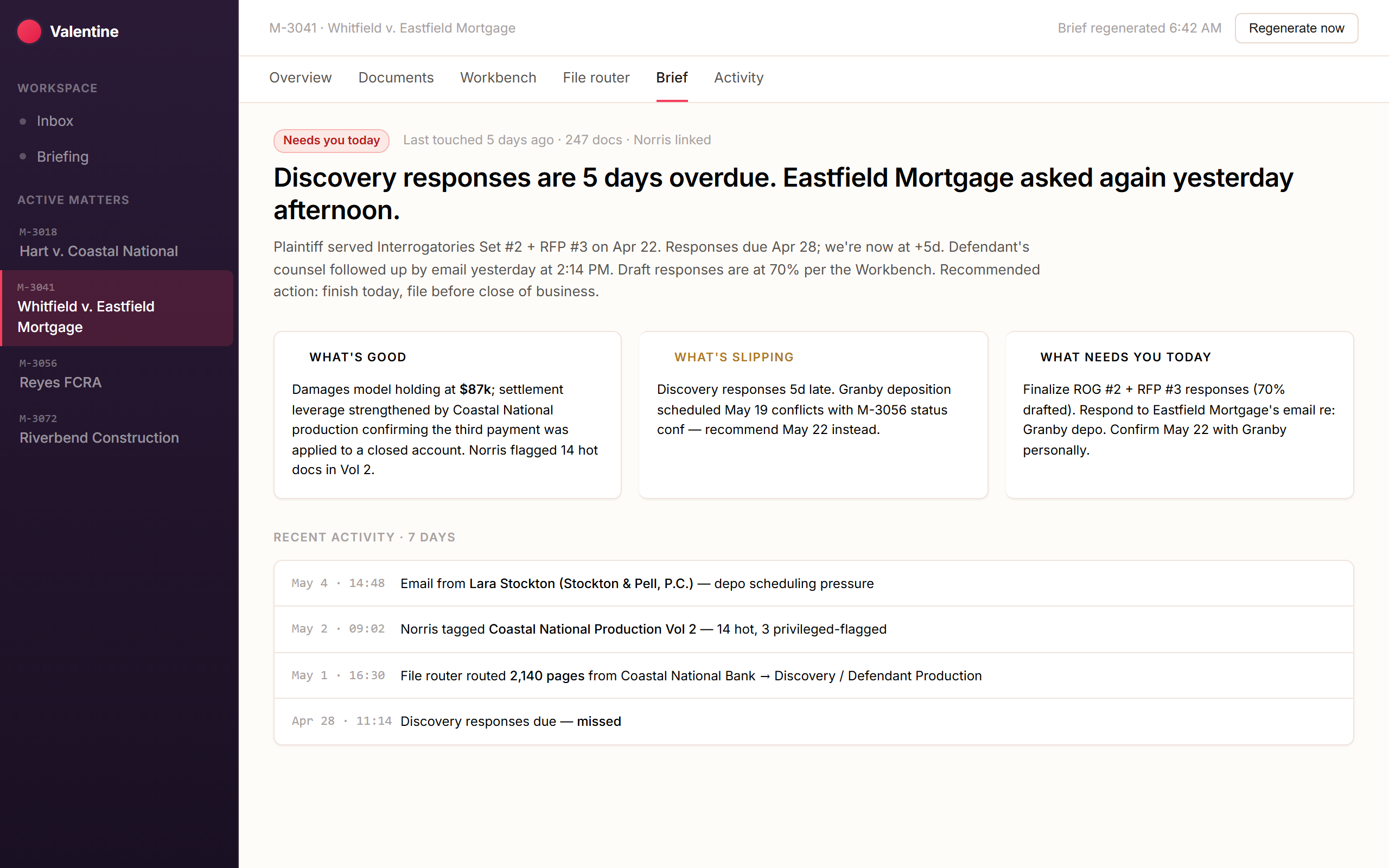
The next move is attached to the matter.
Matter status, client context, value, stage, staff ownership, notes, documents, and Workbench handoff all sit in one place. People can pick up the case without hunting through a dozen systems first.
See the matter command center →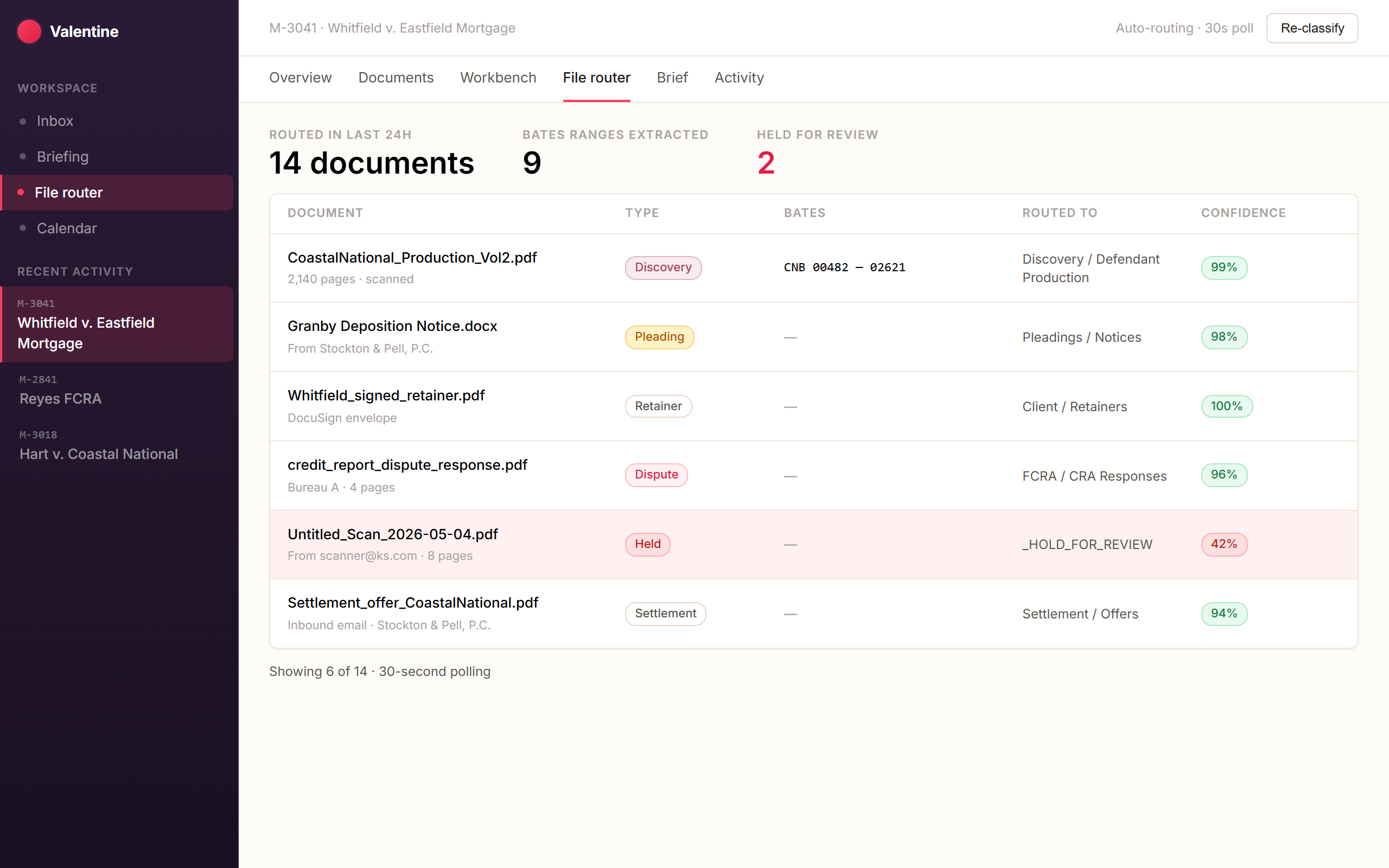
Documents land in the right matter without being touched.
Inbound emails, scanned mail, defendant productions — Valentine's file router reads each document, classifies it by type, extracts Bates ranges and dates as metadata, and routes it to the matter cabinet. From there, productions flow into Norris for discovery review.
Pipeline health is visible before it becomes a surprise.
Reports roll matter count, practice area, workload, outcomes, geography, marketing, operations, AI operations, and pattern findings into one place so leadership can see what is moving and what is stuck.
See Valentine reporting →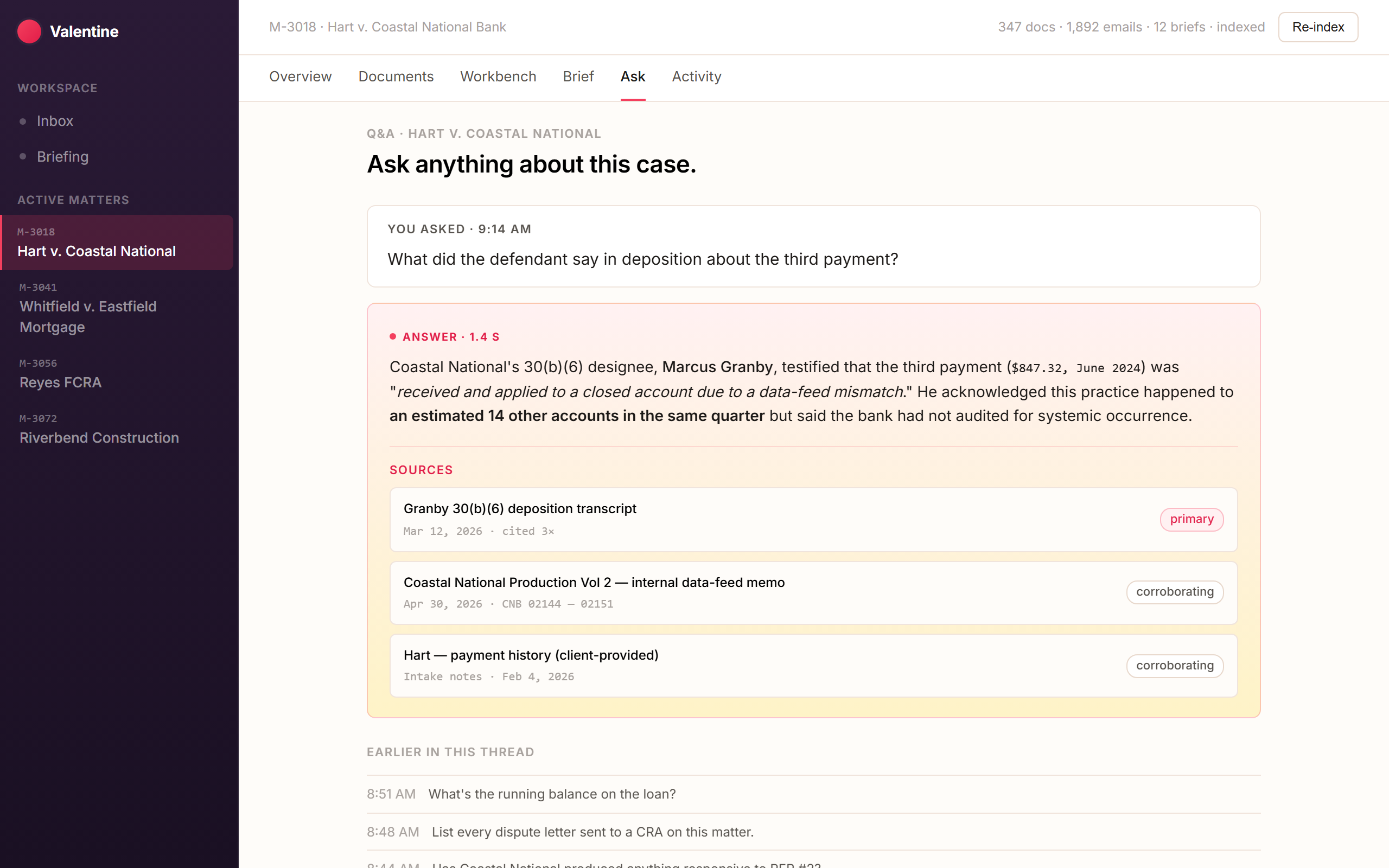
Ask the case a question. Get an answer.
Not a chatbot — a panel that searches every document, brief, and email in the matter and answers with citations back to the documents it found them in. "What did the defendant say in deposition about the third payment?" "What's the running balance on the loan?" Seconds, with sources.
See case-aware QA in motion →Discovery review at machine speed.
Valentine routes a defendant production into the matter; Norris takes the documents from there — splitting bundled productions into fine-grained children, tagging each by document type, and serving them to your reviewers in a focused, keyboard-driven interface.
À la carte: subscribe to one or both.
Meet Norris →
Legal research for the whole law.
Maverick is the research engine joining the Valentine family: searchable case law, federal statutes, regulations, and state statutory law in one answer-first surface. It is being built for many practice areas, not just the work our own firm does.
Early access product. Contact us for pricing.
Meet Maverick →Most "AI" in legal software is a search bar with a spinning logo.
We don't blame anybody — bolting AI onto an existing CRUD system is the only thing you can do when your CRUD system is already five years old. We started over. Every workflow in Valentine has agents in the data path, not on the side. The case-aware AI agents see what you see — the matter, the statutes, the production, the calendar — and act on it. The result: the work is mostly done in the time it takes to get a cup of coffee.
Most legal AI hides the model behind a logo. We don't.
You pick which Anthropic Claude tier runs your matter — Opus when the stakes warrant it, Sonnet for everyday work, Haiku for high-volume tasks. We use Anthropic's latest models on day one. We never choose your AI for you.
Briefing agents, novel arguments, complex reasoning
Routine drafting, document analysis, classification
Pre-screening, tagging, background passes
Live at one law firm.
Klein & Sheridan, the consumer-protection firm that built Valentine, runs every matter through the system.